Bonus Rollover Mechanics and Their Influence on Video Slot Edge Calculations
Lars Foster · Jun 21, 2026
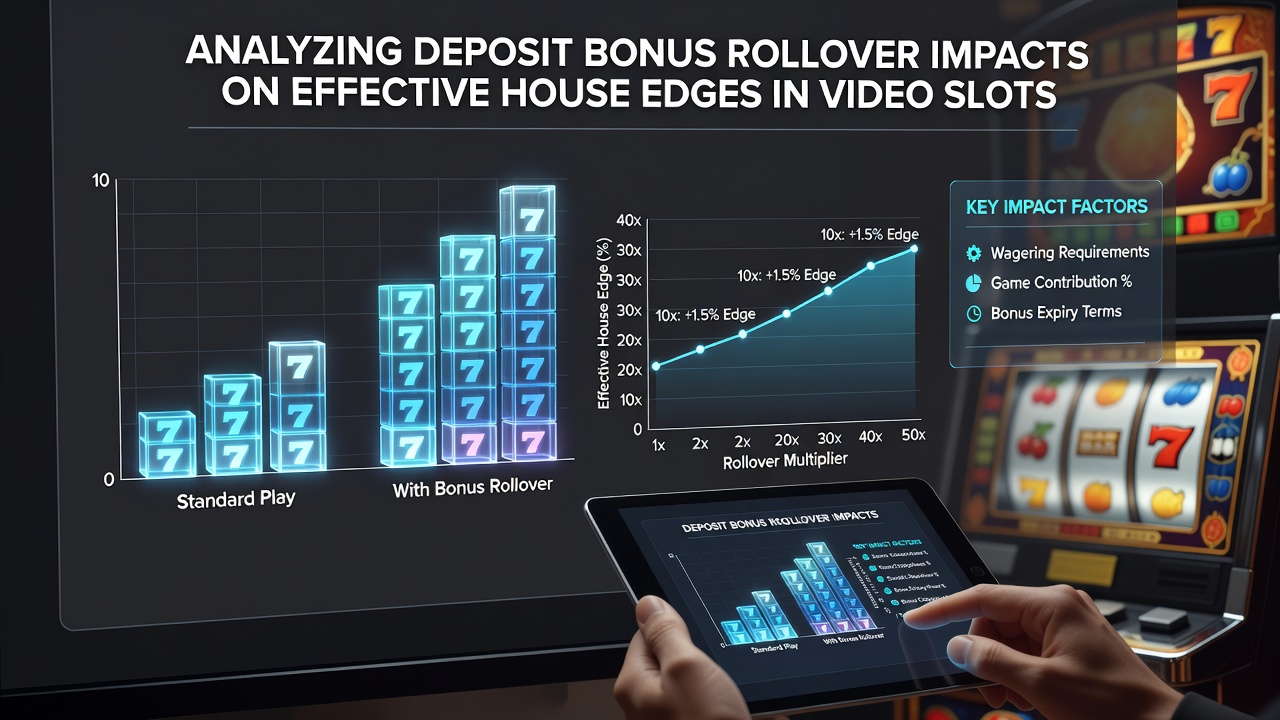
Bonus Rollover Mechanics and Their Influence on Video Slot Edge Calculations
Deposit bonuses in video slot environments introduce additional layers to standard house edge computations, since players must satisfy specific wagering thresholds before accessing any associated funds or winnings. These thresholds, commonly termed rollovers, require bet volumes that scale with the bonus amount and alter the net return profile across extended play sessions. Data from operator reports indicate that typical multipliers range between 20x and 50x the combined deposit plus bonus figure, which stretches the number of spins needed to clear conditions and embeds the original game mathematics within a larger volume requirement.
Core Elements of Rollover Structures
Video slot titles carry fixed house edges that reflect their programmed return-to-player percentages, yet rollover conditions modify the effective edge once bonus funds enter the equation. Researchers at institutions such as the University of Nevada, Las Vegas have modeled these adjustments by factoring in the additional turnover demanded, which dilutes the impact of any single spin outcome over hundreds or thousands of cycles. Contribution rates further complicate the picture, because many operators assign slot games full 100 percent weighting toward the requirement while restricting table games or excluding certain high-volatility titles altogether.
Observers note that players who accept a 100 percent deposit match with a 35x rollover face an immediate increase in required betting volume that scales directly with account size. This structure means the bonus itself carries an implicit cost measured in expected losses during the playthrough period, since each required wager continues to incur the base house edge of the chosen machine. Calculations performed on sample data sets show that effective house edges can shift upward by several percentage points when the rollover multiplier climbs above 30x and contribution rules limit eligible games.
Mathematical Adjustments to House Edge
Effective house edge emerges when analysts divide the total expected loss by the aggregate funds placed at risk, including both player deposits and bonus amounts across the entire wagering cycle. A slot with a published 4 percent house edge retains that figure on every spin, but the bonus portion introduces a temporary overlay that reduces the player's net exposure until the rollover clears. Once the requirement completes, any remaining balance converts to cashable funds and the edge reverts to its standard value for subsequent play.
Simulations conducted across representative paytables demonstrate that shorter rollovers preserve more of the original return percentage, whereas extended multipliers amplify variance and push realized returns closer to the theoretical loss rate during the bonus phase. Figures released by the Nevada Gaming Control Board highlight seasonal fluctuations in bonus uptake that correlate with changes in average session length, confirming that rollover length directly influences how quickly players exhaust promotional balances.

Regional Variations and Reporting Standards
Regulatory frameworks in multiple jurisdictions impose transparency rules around bonus terms, which in turn affect how operators disclose effective edge modifications. In New Jersey, the Division of Gaming Enforcement requires clear labeling of contribution percentages and maximum bet limits during bonus play, allowing analysts to construct more precise models of adjusted returns. Canadian provincial regulators have adopted parallel disclosure practices that reveal similar patterns when aggregated data from licensed platforms become available for review.
European operators governed by the Malta Gaming Authority publish periodic statistics that track bonus clearance rates, and these reports indicate that completion percentages decline sharply once rollovers exceed 40x. Such patterns align with mathematical expectations, since larger multipliers extend exposure to the base house edge and increase the probability that balances reach zero before conditions are satisfied. Industry associations, including the European Gaming and Betting Association, compile cross-border comparisons that further illustrate how regional differences in rollover norms produce measurable divergences in effective player returns.
Practical Examples from Operator Data
One documented case involved a mid-sized European platform that offered a 50 percent match bonus subject to 25x rollover on slots only. Internal metrics shared with researchers showed that average effective house edge during the promotional window rose from the base 3.8 percent to approximately 5.2 percent once bonus funds were included in the denominator. A separate North American operator applied a 30x requirement with a 20 percent contribution cap on progressive titles, which produced a narrower but still detectable lift in realized loss rates according to anonymized session logs examined in 2025.
These examples illustrate consistent directional effects rather than isolated anomalies. When June 2026 updates to certain provincial reporting mandates take effect, additional granular data on bonus performance may become accessible, enabling tighter calibration of models that connect rollover parameters to edge outcomes across wider samples.
Conclusion
Deposit bonus rollover conditions reshape video slot mathematics by extending the volume of play subject to the base house edge and by weighting the denominator of return calculations. Regulatory disclosures from multiple jurisdictions supply the raw figures needed to quantify these shifts, while simulation studies confirm that multiplier size and contribution rules remain the primary drivers. Observers tracking operator statistics continue to refine adjustment formulas that translate published edges into effective values under varying promotional structures, producing clearer pictures of how bonus terms interact with machine programming over complete wagering cycles.