Examining Provider Impact on Return-to-Player Stability in Licensed Slot Markets
Tina Lorenz · Jul 26, 2026
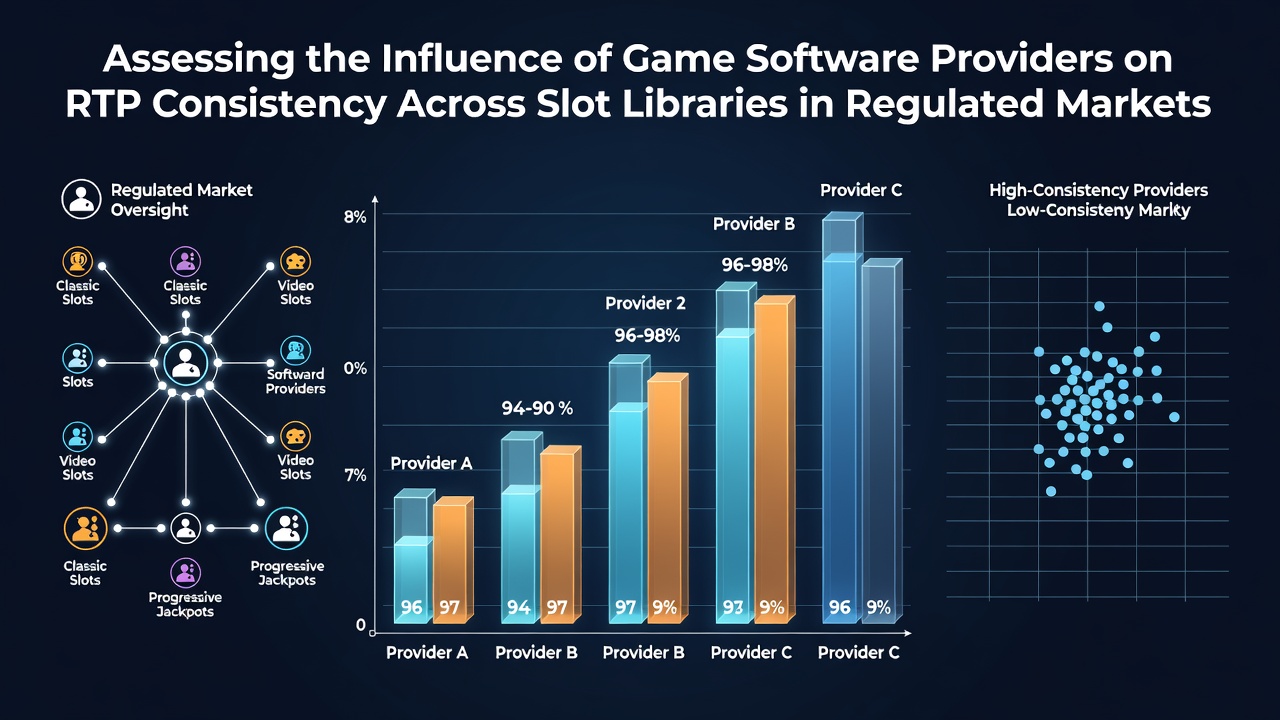
Examining Provider Impact on Return-to-Player Stability in Licensed Slot Markets
Game software providers shape how return-to-player percentages hold steady across thousands of slot titles, and regulators in multiple jurisdictions track those patterns through mandatory testing and certification processes. Data from independent laboratories show that leading developers maintain documented RTP ranges, yet variation appears when the same game runs under different licensing frameworks because each authority applies its own verification protocols.
Core Mechanics of RTP Certification
Return-to-player figures represent the theoretical percentage of wagered money a slot returns over an extended period, and providers submit game files to accredited testing houses before release. Those houses run millions of simulated spins, then issue reports that regulators review before granting approval. In markets such as New Jersey and several Australian states, the same provider must resubmit updated builds whenever any parameter changes, which creates a traceable record of consistency across an entire library.
Observers note that developers with larger internal quality teams tend to produce narrower RTP variance bands, whereas smaller studios sometimes request broader tolerances during initial submissions. Figures released by the New Jersey Division of Gaming Enforcement illustrate that certified titles from established providers deviate less than 0.3 percent from stated RTP when retested after twelve months in operation.
Cross-Market Comparisons of Library Consistency
Regulated markets require providers to publish RTP information either on the game interface or in help menus, yet the actual distribution of those values across a developer’s catalogue differs by region. European authorities, for instance, mandate that every title within a provider’s portfolio meets minimum RTP thresholds, while certain North American commissions focus more on individual game approvals without requiring portfolio-wide uniformity. Research compiled by the University of Nevada, Reno gaming laboratory indicates that providers operating under stricter portfolio rules display lower standard deviations in RTP across fifty-title samples.
Technical Factors Affecting Stability
Random number generator algorithms, reel weighting files, and bonus trigger frequencies all contribute to the final RTP calculation, and any update to one element can shift the overall percentage. Providers therefore maintain version-controlled repositories that regulators can audit. When a developer pushes a global update, each jurisdiction receives the revised build and conducts fresh certification, which explains why RTP values sometimes appear slightly different for identical game names in separate markets.

Those who have examined audit trails point out that providers using the same RNG seed architecture across multiple titles achieve more predictable outcomes, while studios that license third-party engines occasionally encounter wider fluctuations until calibration stabilizes. Data gathered during routine compliance checks in July 2026 will supply further evidence on whether recent standardization efforts reduce these discrepancies.
Role of Third-Party Laboratories and Reporting Standards
Independent test houses such as eCOGRA and GLI operate under contracts with both providers and regulators, supplying standardized reporting formats that allow direct comparison of RTP results. Their protocols require minimum sample sizes and confidence intervals, which reduces the chance that random variation masks underlying inconsistencies. Industry reports from the Canadian Gaming Association document that titles passing through multiple laboratories before launch maintain RTP alignment within 0.2 percent across different regulatory submissions.
Providers that publish annual transparency reports listing every certified title and its tested RTP give regulators and operators clearer benchmarks for library-wide performance. These documents also reveal whether certain game mechanics, such as progressive jackpots or cascading reels, systematically influence the stability of stated return percentages.
Conclusion
Software providers influence RTP consistency through their development processes, version control practices, and cooperation with testing laboratories, while regulators enforce verification standards that differ by jurisdiction. Continued collection of post-certification data across markets will clarify how these elements interact over time, offering operators and authorities measurable indicators of library stability without requiring subjective judgments about individual titles.